Pages

Friday, July 29, 2016

Interview with Sheri Cobb South by Jacqueline Seewald

Well-published Five Star/Cengage mystery writer Sheri Cobb South is the author of more than twenty novels, including the John Pickett mystery series and the critically acclaimed Regency romance, The Weaver Takes a Wife. A native of Alabama, she now lives in Loveland, Colorado.


Question: What is the title and genre of your novel?  Why did you select them?

Answer: The title is Too Hot to Handel, and it’s a historical mystery set in Regency England. It’s the fifth in the mystery series featuring Bow Street Runner John Pickett. I’ve loved the Regency period—strictly speaking, 1811-1820, but for genre purposes more like 1795-1830—ever since discovering the works of Georgette Heyer when I was a teenager. It’s the time Jane Austen lived and wrote, and the combination of elegance and wit makes it great fun to write about. As for the title, it’s a triple entendre: “hot” refers to stolen property, the consummation of the romance, and the Drury Lane Theatre fire of 24 February 1809, which is the novel’s major set piece. As for Handel, it’s not a misspelling, but a pun, since the fire breaks out during a performance of a Handel oratorio.


Question:   What inspired this novel? How did it come about?

Answer: This is the one I’ve looked forward to writing ever since the series began!  The romance between John Pickett and the widowed Julia, Lady Fieldhurst, has been developing slowly over the course of the series. He was smitten from the first, but I knew it would take something drastic to make her confront her own growing feelings for a man so far beneath her socially. In fact, it isn’t until his life is threatened and she’s faced with the prospect of losing him that she’s willing to “throw her cap over the windmill,” so to speak. This is also the only book I’ve ever written that is based on an actual historical event—that being the Drury Lane Theatre fire. Since the cause of the blaze was never discovered, it gave me the freedom to create my own “what if?” scenario.

Question:  Could you tell us a little bit about the heroine and/or hero of your novel?

Answer:  John Pickett was a juvenile pickpocket who’s rescued from a life of crime by the real-life London magistrate Patrick Colquhoun. (His backstory is told in the prequel novella Pickpocket’s Apprentice.) The series opens ten years later with In Milady’s Chamber, when John is a 24-year-old recently-promoted Bow Street Runner. The Bow Street Runners, I should add, were the first organized detective force in England—the forerunners to Scotland Yard. Pickett meets Julia, Lady Fieldhurst, quite literally over her husband’s dead body, when he’s summoned to investigate Lord Fieldhurst’s murder. Although Julia is two years older, she’s very much under the thumb of both societal expectations and her late husband’s family. Over the course of the series, the lady and the Bow Street Runner are thrown together, usually with a dead body somewhere in the vicinity. Julia is able to go places and talk to people in ways Pickett can’t, and she begins to blossom as she realizes she has a talent beyond the purely ornamental.

Question:   Can you tell us about some of your other published novels or work?

Answer:  Besides the John Pickett mystery series, I’ve also written a number of Regency romances, the best-known being The Weaver Takes a Wife. Before that, I wrote five young adult novels for Bantam’s Sweet Dreams series, which is where I got my start. They’re out of print now except for foreign language editions, which kind of freaks my kids out; to them, I’m just Mom.

Question:   What are you working on now?

Answer:  I’m continuing to write the John Pickett series, but I’m trying to alternate them with other things. Right now I’m working on an “old school” romantic suspense novel based on the Mediterranean cruise I recently took with my husband. I credit a steady diet of Mary Stewart and Phyllis Whitney during my teenage years with giving me a craving to travel, and this book is my tribute to those ladies and their work.

Question:   What made you start writing?

Answer: I can’t remember a time when I didn’t want to write! I got my first library card when I learned to write my name—my mother swears I wasn’t yet three years old. As for writing for publication, I decided to get serious about it when I was twenty-eight and saw that big 3-0 looming on the horizon. That seems awfully young now, but it made me ask myself, “Are you going to spend the rest of your life saying ‘someday,’ or are you going to write that book?’ ” The result was Wrong-Way Romance, which was published by Bantam in 1991—and which sells today on Ebay for $50 and up!

Question:   What advice would you offer to those who are currently writing novels?

Answer: This is probably not going to be a very popular answer, but here goes: Resist the urge to rush your book to print before it’s ready. Today’s self-publishing climate can be a godsend to writers whose work doesn’t fit the mainstream mold, but it also offers a great temptation to release inferior work into the world. The old system, frustrating as it often was, served as a gatekeeper that forced writers to hone their skills before their work could be published. Now it’s all too easy to publish work that just isn’t up to the level of quality that readers have a right to expect. And while it’s true that files can be updated and books re-released as new editions, a reputation as a mediocre writer is not so easily shaken. Find a critique group and/or beta reader(s) who will be brutally honest with you. Hire a freelance editor if the mechanics of grammar or spelling are not your strong suit. Do whatever it takes to be absolutely sure of the quality of your work. Remember, it’s got your name on it, and the reputation you establish with that first book will follow you for a long time.

Question:  Where and when will readers be able to obtain your novel?

Answer: It’s available now in both hardcover and Kindle editions. The Kindle version, of course, is available through Amazon. For those who prefer a print edition, all online booksellers offer it. And while you probably won’t find it on the shelves of your local bookstore, they can order it for you, if you ask them to. If a hardcover is outside your price range, ask your library to purchase it. Most libraries have a form patrons can fill out to request a purchase.

Sheri, thank you for an informative interview!


Note: Sheri is available for comments and questions.

Friday, July 22, 2016

TRAVEL REFLECTIONS by Sarah Wisseman

I recently returned from an intense, marvelous trip to Iceland and the countries around the Baltic. Result: my body is tired and my brain is scrambled. Not quite sure what time zone I'm in, or what I'm supposed to be doing yet. But, as my husband says, "it's good to have traveled," and it certainly shakes up the routine.

Iceland was amazing: spectacular geology and bizarre landscapes, from a continental divide (where the North American and Eurasian tectonic plates meet) to geysers reminiscent of Yellowstone and the eerie Blue Lagoon. I particularly loved the Lagoon: where strangers meet, coming out of the steam, with white clay masks (good for the skin!) and the hot, geothermal water is the perfect cure for jet lag.


Scandinavia is stunning in all its varied cityscapes, gorgeous fjords, and way of living. I asked lots of questions about health care, and the response from the locals was uniformly positive: we don't mind paying such high taxes when we get cradle-to-grave care and free university attendance.


                                  Bergen, Norway (on a rainy day)

 (my watercolor of Bergen)

The trip's effect on me is something that is still being sorted out, on many levels. I understand now why Scandinavian mysteries are so dark and the settings gray--that's really how it is, even in high summer, with frequent rain and low clouds. No wonder people celebrate the return of the sun near the Arctic Circle!

As for cruise travel, and ocean boat is a great way to visit multiple ports with a companion who has walking issues, but it's too much, too fast. Today, Estonia and tomorrow, St. Petersburg--no, wait, the ship can't leave port because the wind is holding the boat against the pier and not even a big tug can shift it! And when we finally arrived in the great Russian port after a day's delay, the dramatic contrast between the original grand palaces and wide boulevards with leftover Communist apartment blocks was decidedly creepy. So were the multiple passport checks: twice every time you got on or off the boat, and no straying from the tour group allowed unless you'd purchased a very expensive Russian visa. Sayings that stuck in my mind, "You don't want to be stopped in Russia without papers," (still!!) and "Russians dress like cabbages," (meaning layers). And, "there's no such thing as bad weather, only bad clothing."

                                      St. Petersburg apartment blocks

After I sort out my many and mixed impressions, I'll be able to write again. Next up: the third mystery, "The Botticelli Caper," set in Italy, and a research trip with my daughter to Florence! That trip will be "slow" travel: lots of time in one place, with frequent pauses for sitting in cafes and inhaling Italian food:)

Friday, July 8, 2016

Fiction and Feminism by Jacqueline Seewald

I’m back to “isms” today. This time it’s Feminism. I recently read several articles that I consider thought-provoking and would like to share with you.

Melinda Gates wrote an article for TIME MAGAZINE entitled “Why Poverty Is Sexist.” It appeared in the March 28, 2016 issue. She observes that women are more likely to be impoverished and less likely to get an education and most especially if they are born into poverty. She comments that the potential for many women goes unrealized and unrecognized. Perhaps that is one reason why in fiction those of us who have the opportunity should be creating positive role models for women. Our heroines should be people who inspire other women to achieve and overcome obstacles.

Another interesting article appears in the June 6, 2016 issue of TIME. “The Writer Who Helped Disney Heroines Find Their Inner Feminist” by Eliza Berman is about screenwriter Linda Woolverton who has scripted a number of successful films for Disney, among them: “Beauty and the Beast.” Woolverton’s vision was of a modern princess, not a passive one, who is more at home in a library than in front of a mirror. Her viewpoint is that girls are empowered by role models. She depicts girls and women in non-stereotypical roles.

Re-invention of women’s roles in society via fiction is one way to make an impact. I also believe as a writer in creating strong women characters. For instance, Mary MacGreggor in THE KILLING LAND is no passive princess. She faces adversity with strength of character and resourcefulness.


The same can be said for Kim Reynolds in THE BAD WIFE, a woman determined to save her man by discovering the identity of a murderer even though it places her own life in jeopardy.


Cassandra Lowry, heroine of nontraditional Gothic novel DARK MOON RISING, acts to remove a family curse that has been killing off male members of a great family for centuries.


The role of women in society will need further re-invention and definition as long as women worldwide are treated as second and third class third world citizens. Fiction writers of today have the opportunity to help liberate future generations of women. We may have come a long way, baby, but we still have a lot further to go.

Your comments welcome!


Friday, July 1, 2016

Six Months Later by Susan Oleksiw

Just six months ago, in January, those of us who publish with Five Star/Gale, Cengage got the news that our publisher would no longer accept manuscripts for its mystery line. The news hit a lot of us very hard. Some writers watched their first novel turn into the last one. Others waited for their book to show up at a conference, only to learn the pub date had been pushed back. The bad news took many forms, but in the end it was the same for all of us who write mysteries.

In an earlier posting (found here) I wrote at length about how the abrupt ending of the mystery line affected me. It meant basically the end of the Anita Ray novels and the Mellingham books because publishers are unlikely to pick up another publisher’s series. But as I mentioned then, I had one more book in the pipeline with Five Star, another one ready to go, two paperback editions with Harlequin waiting in the wings, and a story just accepted by Alfred Hitchcock Mystery Magazine.

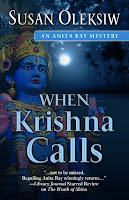
So where am I six months later? The last Anita Ray mystery novel, When Krishna Calls, will be out in August 2016, along with a short story from AHMM (the October issue available in August). The same magazine accepted two more stories, one featuring Anita Ray. I’ve sent another story to Ellery Queen Mystery Magazine. The paperbacks of the second and third Anita Ray novels haven’t appeared yet, but they will.

I was about to send the seventh Joe Silva/Mellingham mystery to Five Star when I got the news. After much thought (and professional editing and a cover design), I published the novel myself. Come About for Murder is doing well, and I’m pleased. None of this breaks new ground. For that I have to turn to my effort to create a new series.

In a few short stories I’ve explored life in a rural area I’ve named West Woodbury, a small town in the poorest county in the Commonwealth of Massachusetts. AHMM has accepted a story set in this world, and I self-published one (Love Takes a Detour) some time ago. The stories come easily, most of the time, but creating a new series character is proving to be harder. I’m not interested as much in her because I know she’s going to survive every encounter. The ones I’m interested in are the characters who may not, or who will come out of the experience so changed that no one will recognize them anymore.

Still, this is the new series that has captured my attention and my imagination. Six months after Five Star shut down its mystery line I’ve written two novels and am rewriting the second one, to bring it more into line with current tastes (that means more action, according to my ever-supportive agent, Paula Munier).

I tell myself the challenge has been good for me because it has made me give up a secure place and try something new. I should have known this was coming after all the time I spent writing about sailing in the seventh Joe Silva and the short story coming out in August (“Variable Winds”). Taking the safe way is called, by sailors, “hugging the shore.” To really sail, to find out what you and your boat can do, you have to leave the safety of the coastline behind and set out into the vast ocean, where the only markers are the wind and sun and your own ability to chart a course and find your way.

I’ve heard from a few of my fellow Stars, but I’d like to hear from more. What has happened in your writing life since getting the news? Successes? Discoveries? If you have something to share, I hope you will.

Friday, June 17, 2016

Sharing the Author Experience

This week I had the pleasure of attending Dorothea Benton Frank's speaking and signing sponsored by one of our indie bookstores, Watermark Books. Approximately fifty people attended, mostly women. Drinks were available for purchase and it was hosted at an outside venue called Abode, a venue I've never been to before. Brightly colored sunglasses were given to the first dozen to come in the door, and photos were taken of us with them on. When Dottie came in she went up and down the aisles and greated many of us, hugging a few she remembered from previous encounters or friends from way back. Instead of telling us about her newest book "All Summer Long," she shared some of the quirky experiences she has had on her current six-week book tour, followed by answering our many questions. She was funny, gracious and delightful and with seventeen novels worth of experience she had a lot to share.

What did I learn from this experience? 

  • Be your true self in front of an audience. People will recognize ingenuous author behavior. And if you're a little nervous they will understand.
  • Talk about what the readers want to hear. Ask them.
  • "Listen" to questions and answer the best you can. If you don't know, be honest.
  • Dare to be human and laugh at your own mistakes or foibles. We all have them, you know. 
  • Smile. People will smile back and feel special.
  • Laugh when things are funny, but never at someone else's expense.
  • Make eye contact with various audience members all around the room. Again, this makes the audience members feel special.
  • Ask questions of the readers, too. What was your favorite part? Who was your favorite character? etc. 
  • Relax. Reminise. Be relatable. 
  • Share a little bit of yourself. The names of authors you enjoy, your favorite books growing up. 
  • Be entertaining. If the audience enjoys your stories and discussion they will no doubt enjoy your book. 
  • Network. There are other authors, book buyers and sellers in the audience. They are readers, too. Be enthusiastic and enjoy yourself.
I'm going to try and use all of these the next time I'm talking to a group and I hope they come in handy for you.

Write on, my friends.

********
Bonnie (BD) Tharp is an award-winning author of women's fiction for FEISTY FAMILY VALUES and PATCHWORK FAMILY.  Also, the author of Kindle ebook short stories: THE CROSSROADS & EARL DIVINE.

I have a new Young Adult manuscript ready for an agent or publisher, whichever comes first. Wish me luck!

Friday, June 10, 2016

Interview With Mystery Writer B. J. Bourg by Jacqueline Seewald

Our interview today is with a very special mystery writer. I will refer to him as the real deal when it comes to writing police procedurals.

B.J. Bourg is a twenty-five-year veteran of law enforcement and has worked as a patrol cop, detective, police academy instructor, SWAT officer, sniper leader, and chief investigator for a district attorney’s office. He is a former professional boxer and a lifelong martial artist. He loves vacationing in the mountains and is especially drawn to hiking, climbing, photographing dangerous animals, and traversing wild rivers in anything that will float. Above all else, he is a father and husband, and the highlight of his life is spending time with his wife and children.


B.J., before we start, I just want to congratulate you on the fine reviews you received from Library Journal and Kirkus among others. 

Question: What is the title and genre of your novel? Why did you select them?

Answer: The title is Hollow Crib and it’s a mystery.

Question:  What inspired this novel? How did it come about?

Answer: When Brandon and Grace were young, I’d take them camping in the Kisatchie National Forest in northern Louisiana. As we explored the area in daytime and at night, I thought it was a great setting for a creepy mystery. I’d tell them scary stories by the campfire and, after they’d go into the tent for the night, I’d stay up by the campfire and plot out what later became HOLLOW CRIB. Earlier this year, Grace and I went on a father-daughter adventure hike in the Kisatchie Forest. Instead of telling her a scary story by the campfire, I read an excerpt from HOLLOW CRIB—she didn’t want to stay the night.

Question:  Could you tell us a little bit about the heroine and/or hero of your novel?

Answer: Brandon Berger works as a detective for the Magnolia Parish Sheriff’s Office. His loyalty to his department and dedication to his job are admirable qualities, for sure, but he finds himself struggling to strike the right balance between his family and his job. This is something that many detectives face in their real lives and there’s no easy way to resolve that conflict. While Brandon always tries to do the right thing in his job, he doesn’t always make the best choices when it comes to his family, and this puts a strain on his marriage, which in turn distracts him from his case.


Question:  Can you tell us about some of your other published novels or work?

Answer: My debut novel is titled JAMES 516 (originally published by Amber Quill Press) and it features a police sniper named London Carter as the main protagonist. I was a sniper myself and, being very passionate about the job, I decided to write something I was dying to read. I didn’t know if anyone else would care to read a book about a police sniper, but I had a lot of fun writing it. It literally flew off of my fingertips and I started to wonder if I’d written it too fast. I was pleased when Amber Quill Press accepted it for publication and later flattered when it won the 2016 EPIC eBook Award for Best Mystery.

Question:  What are you working on now?

Answer: I’m currently wrapping up the sequel to my latest novel, BUT NOT FORGOTTEN, where I introduce readers to a new cast of characters. Clint Wolf is the police chief of a small swampy town called Mechant Loup, and his sidekick is Susan Wilson, a no-nonsense patrol sergeant who moonlights as a cage fighter. In case Hollywood’s reading this; if this series were ever made into a movie, I’d want Gina Carano playing Susan Wilson.

Question:  What made you start writing?

Answer: When I was very young, I started telling stories to get out of praying and reading the Bible. My mom was very religious and she would make my brother and me kneel down in our rooms and pray for what seemed like forever. And then we’d have to read our Bibles. That wasn’t my idea of fun, so I started making up stories to tell my brother. He loved hearing them and I loved telling them, and I later began writing some of them down. I soon discovered Louis L’Amour’s novels and was immediately hooked. I dreamed of being a writer when I grew up and I wanted to write Westerns like my hero. However, life got in the way and it wasn’t until 1998 or 1999 that I decided to pursue that childhood passion. It didn’t take me long to realize the only thing I knew about the Old West was what I’d learned from Mr. L’Amour. I then read a book on writing that suggested I write what I know. At that point, I’d been a detective for about six years and I knew how to solve mysteries, so I began writing in that genre.

Question:  What advice would you offer to those who are currently writing novels?

Answer: Approach everything you do with a beginner’s mind, always hungry for knowledge. Once we think we know it all about a particular subject, that’s when we’ll cease to learn. And above all else, never give up on your dream of being a writer. I’m 45 and I’m still pursuing my dream of being a writer when I grow up.

Question:  Where and when will readers be able to obtain your novel?

Answer: HOLLOW CRIB is now available anywhere books are sold. It can be ordered in hardcover through the publisher’s website at www.cengage.com, as well as through Amazon, Barnes and Noble, and Books-A-Million, and it’s available as an e-book on Amazon.


Questions and/or comments for B.J. are welcome here.

Friday, June 3, 2016

Keeping a Series Fresh (Part 2), by Susan Oleksiw

Recently I talked about one approach to keeping a series fresh (www.susansblogbits.blogspot.com). All of us who write series want to keep the characters and settings interesting and the stories rewarding. But after five or ten books in the same series, we may begin to worry.

First, in three Mellingham mysteries I focused on Chief of Police Joe Silva as a family man. By putting Joe into a more personal setting, I gave the reader a new perspective on my sleuth. But there are other ways to keep a series fresh.

Second, any series relies on a number of secondary characters who could easily take over the main role of protagonist. In the Mellingham series I generally have Chief Silva working with Sergeant Dupoulis but there are others in the police department. Most recently, in Come About forMurder, I introduced Mindy Dodge, a young secretary in the department, twenty-six years old, petite, and taking criminal justice courses. Joe hired her and tells Gwen, "She's the future." Either Sergeant Dupoulis or Mindy Dodge could take the lead in a Mellingham mystery, to give the series a new perspective.


Third, the town of Mellingham is a typical, small New England coastal town, but it is not Joe Silva's hometown and it's not all he knows. Putting Joe into another setting with a murder would give him a larger landscape in which to work, as well as different colleagues. In Last Call forJustice, Joe is out of his territory but cannot stop himself from pushing witnesses for information about a death. In the Anita Ray series, Anita visits relatives throughout the state of Kerala, and in two novel-length cases is involved with murder away from home. In The Wrath of Shiva, a maidservant is murdered at a relative's home, and in For the Love of Parvati, a corpse washed down river during a monsoon seems to be connected with a missing servant and a stalker of the home where Anita is visiting.

Fourth, we live at a time of tremendous change, and many of these changes are worth exploring in crime fiction. I have considered the idea of exploring the main issues of our time--rising numbers of homeless families and single adults, the opioid crisis and ongoing issues with drug use, the fragmented society divided by ever-smaller social divisions of Baby Boomer, Generation X, and Millennial, and other social divisions. Drug use is the topic explored in A Murderous Innocence. This approach holds special challenges for the writer of novels because of the speed with which the social landscape changes (compared to the length of time required for the publication process).

Fifth, every town or city has corners or pockets that are less mainstream or central, with their own habits and quirks. When the mystery is set in Mellingham, I try to explore one particular aspect of the town. In the most recent book, Come About for Murder, the world of sailing is the setting for murder but also a world the reader explores along with Joe. In Friends and Enemies, the reader learns about the closed world of the paper industry. Other pockets of community are knitting or sewing circles, a group of small business men and women, private clubs with their own set of rituals, and church groups.