Pages

Showing posts with label Mellingham series. Show all posts

Friday, May 4, 2018

Acknowledgments, by Susan Oleksiw

Over the weekend I read The Ponder Heartby Eudora Welty (1953), a short book barely one hundred and fifty pages about Uncle Daniel, who loves to tell stories to anyone who will listen and is known for giving things away, anything from fresh eggs to a garden. When I finished I paged through to read the front and back matter. Other than the copyright page, list of publications, and a dedication, there was no extra material--no short bio or acknowledgments or notes or explanations. As soon as I absorbed the absences, as it were, I recalled that this was always the norm--until recently.

When I pick up any book today, including a mystery novel, I'm not surprised to read one or two pages of acknowledgments, and I happily do so. Today we writers thank everyone in print. We thank our agent if we have one, the editor, the copy editor, the proofreader, our friends and Beta readers, the librarians who helped answer a particular research question, the neighbor who admitted to having an esoteric skill and was willing to share it, the expert who took the time to listen through an hour-long telephone conversation and then replied with precise answers, the online friend who explained the lay of the land for a particular location, the distant cousin who passed on local lore, and the friend who suggested a particularly enlightening book to read. Okay, perhaps I am exaggerating, but only a little.

I didn't include an acknowledgments page in my first two mystery novels, but I did in my third. I didn't include acknowledgments in my next three books in the Mellingham series, and offered only two lines in my seventh in the series. But all four Anita Ray books include an acknowledgments page. My only regret here is in not including one for Friends and Enemies, the fourth Mellingham, because I learned an enormous amount about the paper industry in Massachusetts, thanks to some generous members of the business. The paper industry is run like a medieval guild--if you're not born to it or connected to one of the established families, you'll probably never get inside.

Writers, editors, and readers have differing opinions on thanking people in a publication. No one ever thinks, as far as I can tell, that any book arrives in the local bookstore without a lot of help along the way. Nonfiction books are assumed to be the result of more professional assistance than a novel, but that seems to be less and less the case.

During an interview when Murder in Mellingham was published, the first in the series, I mentioned the number of people who had helped along the way. I had mentioned the members in my writers' group, a few other friends, a book reviewer who took the time to read closely and provide a detailed commentary, among others. The interviewer seemed surprised, and commented that it sounded like a group project. I hadn't been considering an acknowledgments page, but if I had, I probably would have dropped it. When the third book appeared, Family Album, I wanted to thank a woman who had taken the time to show me her family's collection of Portuguese embroidery, which appeared prominently in an early scene. Over the years I've developed the habit of thanking readers or experts who have rendered an important review or comment, but otherwise I keep it short.

In the twenty-five years I've been publishing fiction, I only remember one comment on this issue. When Family Album was published, a book reviewer and friend called the seven lines "excessive." I wonder what she thinks now about the ever-growing acknowledgments page.

https://www.facebook.com/susan.oleksiw.author/
http://www.susanoleksiw.com
https://www.susansblogbits.blogspot.com
https://www.pinterest.com/susanoleksiw/
@susanoleksiw

https://www.amazon.com/Susan-Oleksiw/e/B001JS3P7C
https://www.smashwords.com/profile/view/SusanOleksiw
http://www.barnesandnoble.com/s/susan+oleksiw?_requestid=1017995

Friday, April 7, 2017

Writing and Using Dialogue, by Susan Oleksiw

When I was struggling with writing a particular scene in my first mystery, Murder in Mellingham, I recalled Dorothea Brande’s advice to read writers who have mastered the skill you’re struggling with. If your prose is terse, read someone more expansive, such as James Lee Burke. If your sentences and paragraphs run on too long, read someone who has mastered the skill of brevity, such as Agatha Christie.

The standard guideline for dialogue is brevity with a purpose. Conversation between characters can easily become a way of dumping information, telling the reader about important events instead of showing them. Mystery writers tend to tell the solution to the crime in the final chapters, making the story more talky than action. (And I confess to falling into this trap.) In Technique in Fiction, Robie Macauley uses the final lines of James Joyce’s story “The Dead” to illustrate the impact a few carefully crafted lines of dialogue can have.

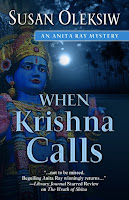
In the Anita Ray series, I use dialogue to develop the setting of South India as well as reveal character. In When Krishna Calls, Anita questions both educated and uneducated Indians, each with his or her own dialectical peculiarities. The rhythm of Indian languages is recognizable in English, and gives me the chance to alter the “feel” of speech. In addition, because of the preferred grammatical forms of South Indian languages, characters have a variety of ways of concealing the truth that only sound awkward to foreigners, introducing an extra layer of confusion and deception.

One of the best examples of the use of dialogue is in the opening scene of The Maltese Falcon. Dashiell Hammett introduces Sam Spade and his secretary, Effie Perine, through a sharp, swift dialogue that is classic and known to everyone who loves crime fiction. But even though this passage is often chosen to illustrate how perfectly dialogue reveals character, it also reveals the ideal balance between prose and dialogue. The five lines of speech are set into one and a half pages of description of the room, the people, and activity. The ratio of dialogue to prose varies throughout the book, with the amount of dialogue increasing.

To understand what dialogue can do in a novel, the reader only need pick up Gregory McDonald’s first mystery, Fletch. The author wanted it to be 98 percent dialogue, and he feels he achieved that goal. The challenge, of course, is to use speech between individuals to establish not only character but also structure for plot and action. McDonald has called himself a post-cinematic writer, by which he means that because we as readers already have so much visual information, the writer doesn’t need to spend time or verbiage on describing a street in Paris at midnight—we’ve seen this street a hundred times before in the movies. We know the world fictional characters live in. If we don’t, a few words will set the stage, drawing on what we do know. This approach places a heavy burden on dialogue to inform, reveal, and move the story forward. Not many writers have followed in McDonald’s path.

When I work on the dialogue of a scene, I think of the best examples I’ve read, but I also think of something I read by Isaac Bashevis Singer, who said, “. . . when I have to hide something, I let the characters speak.”

To find the Mellingham series and the Anita Ray series go to these links:

https://www.amazon.com/Susan-Oleksiw/ 


https://tsw.createspace.com/title/6033762

https://www.smashwords.com/profile/view/SusanOleksiw

http://www.barnesandnoble.com/s/susan+oleksiw?_requestid=1017995


Friday, July 1, 2016

Six Months Later by Susan Oleksiw

Just six months ago, in January, those of us who publish with Five Star/Gale, Cengage got the news that our publisher would no longer accept manuscripts for its mystery line. The news hit a lot of us very hard. Some writers watched their first novel turn into the last one. Others waited for their book to show up at a conference, only to learn the pub date had been pushed back. The bad news took many forms, but in the end it was the same for all of us who write mysteries.

In an earlier posting (found here) I wrote at length about how the abrupt ending of the mystery line affected me. It meant basically the end of the Anita Ray novels and the Mellingham books because publishers are unlikely to pick up another publisher’s series. But as I mentioned then, I had one more book in the pipeline with Five Star, another one ready to go, two paperback editions with Harlequin waiting in the wings, and a story just accepted by Alfred Hitchcock Mystery Magazine.

So where am I six months later? The last Anita Ray mystery novel, When Krishna Calls, will be out in August 2016, along with a short story from AHMM (the October issue available in August). The same magazine accepted two more stories, one featuring Anita Ray. I’ve sent another story to Ellery Queen Mystery Magazine. The paperbacks of the second and third Anita Ray novels haven’t appeared yet, but they will.

I was about to send the seventh Joe Silva/Mellingham mystery to Five Star when I got the news. After much thought (and professional editing and a cover design), I published the novel myself. Come About for Murder is doing well, and I’m pleased. None of this breaks new ground. For that I have to turn to my effort to create a new series.

In a few short stories I’ve explored life in a rural area I’ve named West Woodbury, a small town in the poorest county in the Commonwealth of Massachusetts. AHMM has accepted a story set in this world, and I self-published one (Love Takes a Detour) some time ago. The stories come easily, most of the time, but creating a new series character is proving to be harder. I’m not interested as much in her because I know she’s going to survive every encounter. The ones I’m interested in are the characters who may not, or who will come out of the experience so changed that no one will recognize them anymore.

Still, this is the new series that has captured my attention and my imagination. Six months after Five Star shut down its mystery line I’ve written two novels and am rewriting the second one, to bring it more into line with current tastes (that means more action, according to my ever-supportive agent, Paula Munier).

I tell myself the challenge has been good for me because it has made me give up a secure place and try something new. I should have known this was coming after all the time I spent writing about sailing in the seventh Joe Silva and the short story coming out in August (“Variable Winds”). Taking the safe way is called, by sailors, “hugging the shore.” To really sail, to find out what you and your boat can do, you have to leave the safety of the coastline behind and set out into the vast ocean, where the only markers are the wind and sun and your own ability to chart a course and find your way.

I’ve heard from a few of my fellow Stars, but I’d like to hear from more. What has happened in your writing life since getting the news? Successes? Discoveries? If you have something to share, I hope you will.

Friday, August 7, 2015

Marketing and Promotion Sites by Susan Oleksiw

A recent discussion on the Five Star list prompted me to take a look at what passes in my life for book marketing and promotion online. I hadn't really given it much thought, taking on bits and pieces over the years as part of being a writer. Now was the time, it seemed, to take a look at where I go to sell books or get my name out there. For the last few years I've focused on the Anita Ray series, and with a new book coming out in April 2016, now is a good time to review my approach.

I drew up a list of the sites I think of as part of my online presence, something I would never have imagined in the 1950s, when I first started writing (yes, I was a teenager in the dark ages). This list is longer than I expected. Some of this online business I enjoy and some I don't, so I do what makes sense to me.

I still believe strongly in bookstore and library events, and any other opportunities to meet readers face to face and learn about their interests. That said, here are the sites I have come to frequent unevenly, and find useful. Your experiences may vary, but there are plenty of sites to try.

www.susanoleksiw.com  Yes, I have a webpage, which always needs updating and tweaking.

www.susansblogbits.blogspot.com  Yes, I have a blog, which I try to post to once a week.

Author Central Yes, I have an Amazon author page where I get to gnash my teeth over the occasional snarky review.

Goodreads This site is for readers to connect with books and, if they're interested, with the authors of those books. I post the titles I'm reading along with reviews, and occasionally other readers comment on the reviews. I've also heard from authors who have appreciated what I have posted about their work. I have an author page and occasionally answer questions. If I join a group, I join as a reader. It's considered bad form to push your own books on groups set up to discuss other topics but you can set up a group to talk about your own work. I do giveaways for ARCs, in exchange for reviews, knowing that most people won't review the book but they may pass it on to a friend.

LibraryThing  This site is similar to GR, and can be useful for reviews and giveaways.

The Reading Room This site is a little different from the two above. It began in Australia, in 2010, and claims about 1.4 million members. It also includes the option of giveaways, but I especially enjoy reading the articles collected there.

Wattpad This is a site for posting stories for others to read. Most of them are written by unpublished writers but they attract readers who will then follow the writer and search for other stories or books by the author. Margaret Atwood posted something to the site and got a tremendous response. She wrote about the site also.
http://www.theguardian.com/books/2012/jul/06/margaret-atwood-wattpad-online-writing

Pinterest This site allows you to post images in as many different categories as you want, such as food, flowers, or whatever. Here I post articles I have enjoyed, mostly on writing and publishing, and Indian recipes. I started one on book covers and then neglected it.

Twitter I have used this a handful of times. If I have something pithy to say I usually inflict it on the television while I'm washing dishes.

BookDaily.com This site has a lot of material directed to self-published writers but I enjoy some of the articles.

DorothyL I enjoy this chatlist for the variety of people who post and the book titles I come across. There is sometimes too much conversation about television.

Short Mystery Fiction Society This is a very interesting group of writers of short fiction who offer solid information on publishing including new venues, how-to articles, and general support. Some of the members have published over a thousand short stories and willingly share advice and opportunities.

Facebook  I have a number of friends who live in other parts of the country and overseas, and I am grateful to FB for letting me stay in touch with them. There is little to no chance that I'm going to sit down and write a letter, print out photographs, and head off to the post office at least once a week in order to stay in touch with them. FB has allowed me to remain close to friends I rarely see. FB has its flaws but it also has its strengths. I announce books, blog posts, and events, but I'm otherwise interested in the general conversation among members/friends.

When I first began writing this post I thought it would be quick and easy, with just a few sites listed. I'm surprised at the number, but I know that other writers have far more sites they visit. I check in with certain blogs and occasionally leave comments, and I always appreciate comments on mine (like this one).

Marketing and promoting a book through the Internet is a time-consuming process. But it is for me a lot easier than promoting my book back in 1993. My publisher, Scribner, sent out review copies only to the big guys, and the rest was up to me. If I wanted more reviews or more anything, I had to call each individual newspaper and ask for an interview or the name of someone to send a review copy to, or buy a list of libraries and send out 2,000 postcards. In 1993 I sent a postcard and personal note to every single library in Massachusetts, and another thousand cards to other libraries in the US. I did the same for my next book, in 1994. No one sends postcards anymore.

Writers will always have to take a role in selling their books, and for many of us it will never be easy. But I'm willing to use whatever technology is available, even if I'm not very good at it. I count myself lucky to have the option and the support of a good publisher, Five Star.