Pages

Showing posts with label The Anita Ray series. Show all posts

Friday, November 4, 2016

Publishing and Its Vagaries by Susan Oleksiw

About a year ago those of us who publish with Five Star learned that things were changing. I thought this meant the end of the Anita Ray series, and wasn’t sure if I could continue it with another publisher. To my surprise, I sold the two books in the series to Harlequin, for their worldwide mystery club. The Wrath of Shiva came out in mass market paperback on November 1.

The Anita Ray series is an object lesson in the vagaries and subjectivity of publishing. When I began writing the series, I struggled with defining the lead character, Anita, and her setting, Hotel Delite. I wanted the mix of Indian and non-Indian people because even in villages I encountered variety and extremes in population. Anita emerged in a short story I sold to Alfred Hitchcock Mystery Magazine. “A Murder Made in India” appeared in October 2003.

I had trouble selling the first book, wrote another, and after a while sent that to Tekno/Five Star. Then came the fireworks. Marty Greenberg, co-founder with Ed Gorman, had medical problems, and his wife, Roz, took over. She bought the manuscript. Then he died and she fought for control of the company.

Through changes in editors, Five Star took three more Anita Ray mss. Harlequin bought the first, Under the Eye of Kali, for their worldwide mystery line but turned down the second one. I kept writing, and then as editors changed again and again at Harlequin, I decided to try another Anita Ray. I sent in the third book in the series, For the Love of Parvati. The editor inquired politely, “It looks like there’s another one in the series before this. Can we see that one too?” I sent in The Wrath of Shiva. Yes, the one turned down earlier. The editor bought both titles.

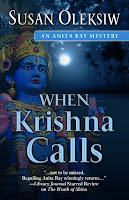
I don’t yet have a pub date for the third book, but I look forward to another gorgeous cover. And in a few months, I hope to interest Harlequin in the fourth Anita Ray, When Krishna Calls.

The point of all this is to remind myself and other writers that there is no order or sense or logic to publishing. Editors make subjective decisions every day over every manuscript even when they think they’re being rational and logical and calculating the odds on sales. Whenever I think about this I could feel better or worse, but mostly I feel the door is still open. I don’t know what will happen to the Anita Ray series, but I know there is still opportunity out there.

The fourth Anita Ray story, When Krishna Calls, has drawn a few four and five star reviews and seems to be doing well. It is the only book I've written that has not received a review or mention in the big reviewers: PW, Kirkus, or Library Journal. Despite that, readers and librarians manage to find it.

You can find the Anita Ray books here  and the lovely new paperback of The Wrath of Shiva here.


Friday, September 2, 2016

Social Change and Crime Fiction, by Susan Oleksiw

Last month, while visiting friends in Washington State, we stopped at a huge tulip nursery. We were out of season, and the farm was almost empty except for a few men tending one of the gardens near the gift shop. We chatted with the woman behind the counter, talking about farm issues in the state, the increasing number of turbines and solar panels on farmland, and the issues surrounding migrant workers. She asked about temporary workers in New England, and that put me in mind of our many small farms.

Crime fiction has many virtues but one of its least discussed is the way it records the everyday world and social change. The isolated socially stratified villages of Miss Marple give way to housing developments sprouting in former pastures, with a wider variety of residents.

This attention to the contemporary world in crime fiction is one of its strengths. It would be hard to set a mystery in any part of New England today that didn't include some acknowledgment of the diversity of its people. When I imagine the typical scenario in an urban setting that could lead to the discovery of a murder, I come up with at least two or three ethnic groups. A businessman works late to cover up his embezzlement, but his midnight departure is noted by the Brazilian cleaning crew. He takes a taxi driven by an East African because he missed the last subway. The driver detours around road construction, where the workers are white, Latino and African-American. He passes drivers heading into the Flower Auction, where women of all heritages make their purchases for their flower shops and pick up a few foreign words as they negotiate.

In the Anita Ray stories, I get to bring together a diverse population in the foreigners visiting Hotel Delite as well as in the many different caste groups of Indians who populate a village or neighborhood. One character's distinctive viewpoint might be tied tightly to his social standing in a small village, and another's might be influenced almost entirely by her exposure to life overseas as a student. Both perspectives give the writer tools for developing the mystery and readers something to ponder.

Some writers do more with this aspect of crime fiction than others. In the Supt. Peter Diamond series, Peter Lovesey paints detailed picture of a theatrical production that doesn't miss a detail, in Stagestruck. Lots of novels are set in the theater, but Lovesey explores every corner, teaching the reader things about the theater we could never learn otherwise.

In "Crimson Shadow," a short story in Always Outnumbered, Always Outgunned, Walter Mosley takes the reader step by step through the process of preparing a meal from a rooster a teen has stolen and killed. This is the background for a dialogue between the teen and the rooster's owner. There are many levels to this story, and much to admire, but I love it for the way the author uses the teaching of a skill to reach a young person, and to remind everyone of what we used to know how to do and used to do regularly. Each of these stories is richer for the accuracy of its depiction of the people as well as the story line.


In the Anita Ray series, Anita moves through layers of society, her behavior acknowledging the change in social position. It would be impossible to tell a story set in India without a diverse population. In The Wrath of Shiva, Anita must remember to conduct herself in a manner the senior female member of the family will find acceptable, interact with the family servants, and maneuver around the village shop owners. But in the most recent book, WhenKrishna Calls, Anita must assert herself against a village moneylender and uses her caste status to do so.


Friday, July 1, 2016

Six Months Later by Susan Oleksiw

Just six months ago, in January, those of us who publish with Five Star/Gale, Cengage got the news that our publisher would no longer accept manuscripts for its mystery line. The news hit a lot of us very hard. Some writers watched their first novel turn into the last one. Others waited for their book to show up at a conference, only to learn the pub date had been pushed back. The bad news took many forms, but in the end it was the same for all of us who write mysteries.

In an earlier posting (found here) I wrote at length about how the abrupt ending of the mystery line affected me. It meant basically the end of the Anita Ray novels and the Mellingham books because publishers are unlikely to pick up another publisher’s series. But as I mentioned then, I had one more book in the pipeline with Five Star, another one ready to go, two paperback editions with Harlequin waiting in the wings, and a story just accepted by Alfred Hitchcock Mystery Magazine.

So where am I six months later? The last Anita Ray mystery novel, When Krishna Calls, will be out in August 2016, along with a short story from AHMM (the October issue available in August). The same magazine accepted two more stories, one featuring Anita Ray. I’ve sent another story to Ellery Queen Mystery Magazine. The paperbacks of the second and third Anita Ray novels haven’t appeared yet, but they will.

I was about to send the seventh Joe Silva/Mellingham mystery to Five Star when I got the news. After much thought (and professional editing and a cover design), I published the novel myself. Come About for Murder is doing well, and I’m pleased. None of this breaks new ground. For that I have to turn to my effort to create a new series.

In a few short stories I’ve explored life in a rural area I’ve named West Woodbury, a small town in the poorest county in the Commonwealth of Massachusetts. AHMM has accepted a story set in this world, and I self-published one (Love Takes a Detour) some time ago. The stories come easily, most of the time, but creating a new series character is proving to be harder. I’m not interested as much in her because I know she’s going to survive every encounter. The ones I’m interested in are the characters who may not, or who will come out of the experience so changed that no one will recognize them anymore.

Still, this is the new series that has captured my attention and my imagination. Six months after Five Star shut down its mystery line I’ve written two novels and am rewriting the second one, to bring it more into line with current tastes (that means more action, according to my ever-supportive agent, Paula Munier).

I tell myself the challenge has been good for me because it has made me give up a secure place and try something new. I should have known this was coming after all the time I spent writing about sailing in the seventh Joe Silva and the short story coming out in August (“Variable Winds”). Taking the safe way is called, by sailors, “hugging the shore.” To really sail, to find out what you and your boat can do, you have to leave the safety of the coastline behind and set out into the vast ocean, where the only markers are the wind and sun and your own ability to chart a course and find your way.

I’ve heard from a few of my fellow Stars, but I’d like to hear from more. What has happened in your writing life since getting the news? Successes? Discoveries? If you have something to share, I hope you will.

Friday, May 6, 2016

Debt in Anita Ray's World, by Susan Oleksiw

The world of India, both modern and traditional, offers unlimited stories--about people and places and gods. I never have to think up a story. The challenge for me is to keep up with the onslaught of ideas that billow out of an image I encounter in a museum or an article I glance at while turning the pages of a newspaper. The story at the heart of When Krishna Calls is one such idea mixing modern and traditional worlds in India.

One of the first things I learned when I arrived in India in late 1975 was that everyone below the westernized middle class was in debt. This is not the debt of student loans, or a mortgage that makes newlyweds "house poor." Nor is it the kind of debt some investors carry with the expectation that in the end they'll reap great rewards.

In traditional India, among lower-income caste groups, debt is essential to the economy. Money circulates in different ways in different strata of society, but at the lowest level, the point of debt is to keep money moving among people. Debts are repaid because no one wants to be shut out of the economy. The interest rate might be high, sometimes up to ten percent a month, but the total amounts borrowed are small and the spending can be significant in filtering through several businesses. The moneylender is usually someone well known to the borrower, the owner of a local vegetable stand or the employer of a maidservant or gardener. Whoever it is, it is rarely a bank.

And then there is the modern version of this loan business, and this is where things change. Large amounts of money change hands, much of it hidden in sham ownership deals, and all of it beyond the reach of the government. And the men who make the loans are not anything like the friendly vegetable seller. And you can guess which one has the greater influence.

This is the story behind When Krishna Calls. An employee of Hotel Delite goes missing, suspected of killing her husband, and is taken captive by a known loan shark. But he isn't interested in her. He's interested in something else.

Anita Ray, always ready to help, wants to find Nisha, someone she likes and admires. But when she finds out her Auntie Meena is involved, Anita realizes much more is on the line, perhaps more than she's ever had to deal with.

Once again, traditional and modern India clash before they blend. And Anita is pushed to the brink when she tries to rescue both Nisha and Auntie Meena.

When Krishna Calls is the last of the Anita Ray mysteries to be published by Five Star/Gale, Cengage. It will appear in August 2016. But I know there will be more adventures for Anita Ray.

Available for preorder now.

http://www.amazon.com/When-Krishna-Calls-Anita-Mystery/dp/1432832255%3FSubscriptionId%3DAKIAIC4DTHWMHZAANS6Q%26tag%3Dspeculativefic05%26linkCode%3Dxm2%26camp%3D2025%26creative%3D165953%26creativeASIN%3D1432832255


Friday, April 1, 2016

Details, Details, Details, by Susan Oleksiw

The first Anita Ray story appeared in Alfred Hitchcock Mystery Magazine, in 2003. The first book in the series, Under the Eye of Kali, appeared in 2010 from Five Star/Gale Cengage. The fourth, When Krishna Calls, will be published in August 2016.

Few readers are aware of the range of work that goes into creating a mystery series. As a young reader in elementary school I was entranced by good stories. It wasn't until I was almost a teenager that I realized I knew someone who had actually published a book. It could have been a one-hundred page pamphlet on changing flat tires and I would have thought he was a genius. I hadn't yet thought about breaking the task down into manageable parts.

A successful series involves a lot of details that may not seem to be closely linked to the casual reader. But writers know better. If I begin with a certain type of character to be the sleuth, that choice will influence the period. Am I locating the story in the present or the past? And what about location? Is the story set anywhere in the United States, or in another country? Does the town or city have to be described in detail as part of the story?

And then I begin to zero in on the details of description. The first few efforts to define Anita Ray, or a young woman living in India and solving crimes, didn't work, in my opinion. I refined and added or deleted details. Creating a character with both Indian and American parents gave her greater freedom of movement as well as allowing her the opportunity to comment on the traditional culture she lives in.

My next concern was titles. As the two examples above indicate, I wanted to use the name of a Hindu deity in each title, one that would suggest to the reader some of the concerns in the story line. In the first book, Kali, a wrathful deity in one form and a loving beautiful young girl in another, is invoked in both forms, but in the end takes on an unexpected role. In the second book, The Wrath of Shiva, the Hindu deity is invoked in a form that is a warning to a group of smugglers. And in the third book, For the Love of Parvati, the theme is obvious in the title. In the fourth book, When Krishna Calls, the forms of love underlie the actions of the characters.

When it came time to reprint the books in trade paperback. I wanted to continue the consistency across covers, as a way of tying the individual titles together. As a result, I asked a designer to create a basic format that I could use for each book, making each one distinct by the specific cover photo used. This has worked well, and I now have three Anita Ray titles available in trade paperback, with all three tied together by cover design and titles.


 All are available from Amazon as trade pb and also as ebooks.

http://www.amazon.com/Under-Eye-Kali-Anita-Mystery/dp/0983600082

http://www.amazon.com/Wrath-Shiva-Anita-Ray-Mystery/dp/0991208218

http://www.amazon.com/For-Love-Parvati-Mystery-Volume/dp/0991208293