Pages

Monday, March 26, 2012

Savvy Secrets of Success


Savvy Secrets of Success: What Do Charles Dickens and Lady Gaga Share?
by Jacqueline Seewald

Charles Dickens and Lady Gaga are examples of celebrities that respectively had and have the ability to build a platform, a brand, that’s hugely successful. Charles Dickens’s novels were vastly popular. Part of that had to do with knowing how to become a literary superstar. Modern day Lady Gaga is also a genius at self-promotion and creating publicity. So what are the secrets to their success? And how can that help the rest of us? What makes Dickens and Gaga so popular and therefore successful?


Dickens was born exactly 200 years ago. He didn’t come from wealth—quite the opposite. He drew upon his childhood experiences to write vivid, memorable scenes. In his youth he wanted to be an actor but worked as a reporter. Later on, he wrote wonderful books—however, he wrote for money. He also wrote for his audience. He cultivated a large readership by providing dramatic readings. And he knew how to merchandise as well, for example, timing “A Christmas Carol” for the holiday season.

As for Lady Gaga, she has also invented herself as a public persona. Her elaborate costumes may be a disguise of sorts but they are part of her creativity. People may want to hear her sing, but they also want to comment on each new outlandish costume creation. No problem for Gaga to write a bestseller if she chooses or call attention to bullying as she has done in launching the Born This Way Foundation.

So what can we learn from these two celebrities in launching our careers? Probably that we need to draw from our own experience of life, to be genuine, to embrace others, talk to people, let them know we exist. Key words are the three P’s: promotion, publicity, and platform.

Here’s a checklist of promotional tools intended to create publicity and build a platform for authors with a new novel:

l. Establish a website.

2. Create a blog.

3. Volunteer to guest blog.

4. Send out news releases.

5. Make public appearances (libraries, bookstores, etc)

6. Get involved in social networking (Facebook, Twitter, Goodreads, etc.)

We may need to think outside the box to be as creative in publicizing our work as Dickens and Gaga. My latest novel DEATH LEGACY, a romantic mystery thriller, is on the launch pad. I am currently offering a Goodreads giveaway of three advance review trade paperback size copies of my novel. (It’s a start!)

http://www.goodreads.com/giveaway/show/22729-death-legacy


Any thoughts or comments are very welcome in this forum.

Sunday, March 25, 2012

Timeless Advice

So sorry reader and writer friends, I missed my blogging date. I'm two days late.Too many things on March's calendar and I never noticed that March has 5 Fridays. I do have some notes to share from a critique partner of long ago.
I was writing my first children's book  and he offered some much needed advice for three areas of my writing which needed help. I believe they are still relevent today.

Offering too much explanation, Using the power position, and Changing tense.
Here's what he had to say:
Offering too much explanation: As Brown and King point out you must Resist the Urge to Explain (RUE). You belabor points and that steals zest from your prose while clobbering your readers with unneeded explanation. Hearts always beat in chests. Nodding is a sign of agreement. You simply don't need to amplify.Not only will this quicken the pace(let's face it, between the explanations and ponderous language, the story moves rather slowly). Leaving out detailed explanation will force your reader to think.  Remember RUE as much as possible.

Using the Power Position: While not every fiction author knows it,books on essays and language point out that every sentence,paragraph, and chapter have a Power Position. A chapter's power position is the last paragraph. A sentence's power position is the last word or phrase before a mark of punctuation.
               "God bless America," cried the bishop.
                The bishop cried "God bless America.
The emphasis is clearly on the the last three words, but we don't want to emphasize "cried the bishop" unless it is meaningful to the story context. It's possible, on sentences that have internal commas to use them as power positions, as well as the sentence's final punctuation mark. Pretty advanced stuff, but someday you'll do it instinctively. Don't juggle phrases and sentences to put everything in a power position. Make flow and readability your first priority, then look for ways to move/sneak important stuff into more powerful positions.

Changing Tense One of my biggest gaffs is changing tense, moving words from past tense to present tense to add immediacy and drama. I'm trying to break myself of the habit and you should too.There are times when the change is acceptable ( according to Janet Burroway,FSU fiction professor, these moments are few and far between), but the shift sometimes works in peak drama: Mary swung back and forth on the thin rope, grabbing at the clif's rock face, trying to arrest the sickening feeling of the free-fall. Most of the time you and I need to keep tense consistent within a sentence.

My critique partner would like that I shared his help to me in this blog.
Mary

Monday, March 19, 2012

The Value of Writer's Conferences

By B.D. Tharp

This weekend was the Kansas Writers Association "Scene" conference at the Wichita Hyatt. Friday night's event was a Pitchapoolsa, and it was unbelievable. Everyone who attended was given one minute to pitch their book. Some of our author attendees were awesome, dramatic, precise, and very well prepared. There are an amazing bunch of stories in the making. And the editors and agents were gracious, encouraging, and positive. Who could ask for more?

Saturday started early, the first speaker began at 8:00 AM. Some of the topics included:

  • Story Structure to Rivet the Reader
  • Ebook and Traditional Publishing, Advantages & Disadvantages
  • Finding the Right Agent or Publisher
  • The Art of the Pitch
  • Promotion, Media, and Branding

Subjects were presented by a host of fabulous industry experts:

I'm exhausted, jazzed, and ready to try the things I learned to better promote my novel FEISTY FAMILY VALUES, and find a home for my next novel, PATCHWORK FAMILY.

Like the cherry on top of the parfait I thoroughly enjoyed the great group of attendees from Kansas and surrounding states. Writers are readers and we know and share in the challenges and joys of being authors. No matter how much your family loves you if they aren't writers, they don't understand the writer's life. It's a bit of a roller coaster ride.

To find out about conferences in your area try Shawguides.com. I usually try to attend one conference a year, and if there are a couple in the Midwest that aren't too far a drive and I can share expenses with someone, then I try for two. They're intense and well worth a writer's time. Write on, my friends.

Friday, March 2, 2012

A Visit from the Grammar Police

Every now and then I come across an article or review in which the writer gives vent to his or her favorite (or least favorite) verbal failings among contemporary writers. We all have them, but I always try to remind myself that every writer has a weakness or two, and the point of publicizing them is to give all of us a chance to learn and improve our own work. Writing well is a lifelong learning process, and when we stop learning, we stop growing. Here, to add to your own personal list of grammar sins to watch out for, are a few of my obsessions.

I am obsessed with the proper use of the direct object for personal pronouns. If I gave the book to you, and you gave it to George, and George decided he didn’t like it and gave it Melinda, why on earth does it transpire that Melinda decided to wrap it up and give it as a gift to Harry and I? What happened to me?

Then there are the words that are fast fading, and I miss them. I cringe whenever someone tells me that a reviewer has called a book marvelous and lavished it with fulsome praise. For those of you not cringing at this moment (or laughing at the reviewer’s sneaky joke), fulsome is related to false, not full. Fulsome praise is false praise, best translated today as smarmy.

Then there are the now ordinary usages that occasionally produce startling images. If you live in a college town and order bacon and eggs and pancakes (and don’t have to worry about high cholesterol), and the waitress asks you if you want them together, you had better be careful of your answer. It’s best to reply to the possibly overeducated young that you prefer them simultaneously rather than together—a mixture that is likely to appear on the plate unappetizing at best.

There are some words that probably can’t be recovered. Career is one of them. The sense of careening is lost now, and those of us who occasionally find ourselves writing career instead of the more idiomatic careen usually cross out the error and make the change. And, of course, the original meaning of careen is pretty much lost also, just like a ship might be from leaning, or careening, too far over in a high wind.

But if I have to give up some of my favorite words, I get to use new ones, or old ones with new meanings. I especially like troll, which I find blinking in my brain whenever I come across someone who delights in finding errors in other people’s work and then pointing them out to everyone they encounter.

Words are fun, and I wouldn’t be a writer if I didn’t try to learn and use new ones, expand my vocabulary as a way of making my sentences more precise, and seek out and learn from other writers whose subject matter is different enough from mine to promise new words and ideas.

If you have favorite words disappearing or changing, let me know. I’m always ready to add to my list of words to watch.

Wednesday, February 22, 2012

And the Giveaway Winner Is...

Hi,

As promised, I'm announcing the winner of a Harlequin Worldwide Mystery paperback copy of The Drowning Pool, a Kim Reynolds librarian sleuth romantic mystery novel. I really wish that
I could send each of you a copy!


However, hardcover copies of the novel are available in libraries worldwide, as well as in all ebook formats from L&L Dreamspell, and in a new paperback edition at Harlequin's online bookstore.

Without further ado, the randomly chosen winner today is: Ellis Vidler.

I'd like to thank everyone who dropped by, read my blog and took the time to comment.

As you see, I read each comment and responded. I appreciate your support!
Jacqueline Seewald

Monday, February 20, 2012

Beautiful Beginnings

by B.D. Tharp

Don’t you just love when the first page of a novel is so intriguing it grabs you and won’t let go? It doesn’t matter what genre either. I love to read books that I can’t put down. You know the ones I’m talking about…the ones you lose sleep over, the ones that replace your cooking time and force the hubby to eat cold sandwiches or cook himself.


Here’s some examples:

“Though she was careful not to show it, Madeline Singer did not fall apart when her youngest child left for college. In the Atlanta suburb where she lived, women wilted all around her. Tears fell. Antidepressants were prescribed.” ~Ten Beach Road by Wendy Wax.

(Makes me glad I don’t live in her neighborhood. And I wonder why Madeline didn’t fall apart. Is she stronger than the rest of us mothers?)


“Until the drowned girl came to Laurel’s bedroom, ghosts had never walked in Victorianna. The houses were only twenty years old, with no accumulated history to put creaks in the hardwood floors or rattle in the pipes.” ~The Girl Who Stopped Swimming by Joshilyn Jackson

(So why is there a ghost visiting Laurel? Who was the girl who drowned? Had she been “visited” by ghosts before? Why?)


“He was the only child in a house full of doubt. In bed each night, though it wasn’t dark – the floor lights his father had installed – and it wasn’t entirely private – the nursery monitor both parents refused to give up – he rehearsed the things he was certain of, using his fingers to number them. He was just a little boy, but he wouldn’t allow himself to sleep until he’d gone through both hands twice.” ~The Winters in Bloom by Lisa Tucker

(Who is this lonely child? Why are his parents so protective? Did he have nightmares? Was he ill? What had happened to make the house full of doubt?)


See what I mean? Each one introduces the first character very quickly and some sort of tension or question that touches them. All of them have the reader wondering “why” and “what will happen next”. Most people enjoy finding the answers a little piece of the puzzle at a time. No data dumps, please. Let them discover crumbs that will lead them down the path to the truth in the story, or the lie, of course.


Make your beginning important, something that can’t be skimmed or skipped. “Hook” the reader and reel them into the story and they’ll be happy to follow your line to the end.

Write on, my friends.

Friday, February 17, 2012

How to Originate Ideas for Writing


How to Originate Ideas for Writing
By Jacqueline Seewald

I am often asked this question by readers: where do you get the ideas for your novels? I answer this question by saying I don’t just sit at my computer all day and pull ideas out of thin air. The ideas originate from living life as fully as possible. I am interested in the people and places around me. I pay attention. I observe with all of my senses. Reality gets mixed with imagination in my writing.
Writers are people, many of whom live interesting and unusual lives. Some of us tend to find the unusual in the ordinary. It all plays a part in what writers ultimately designate as “fiction.”
I am also a voracious reader as are many other authors. I read a great variety of books, magazines and newspapers. I read both fiction and nonfiction. Reading stirs imagination.
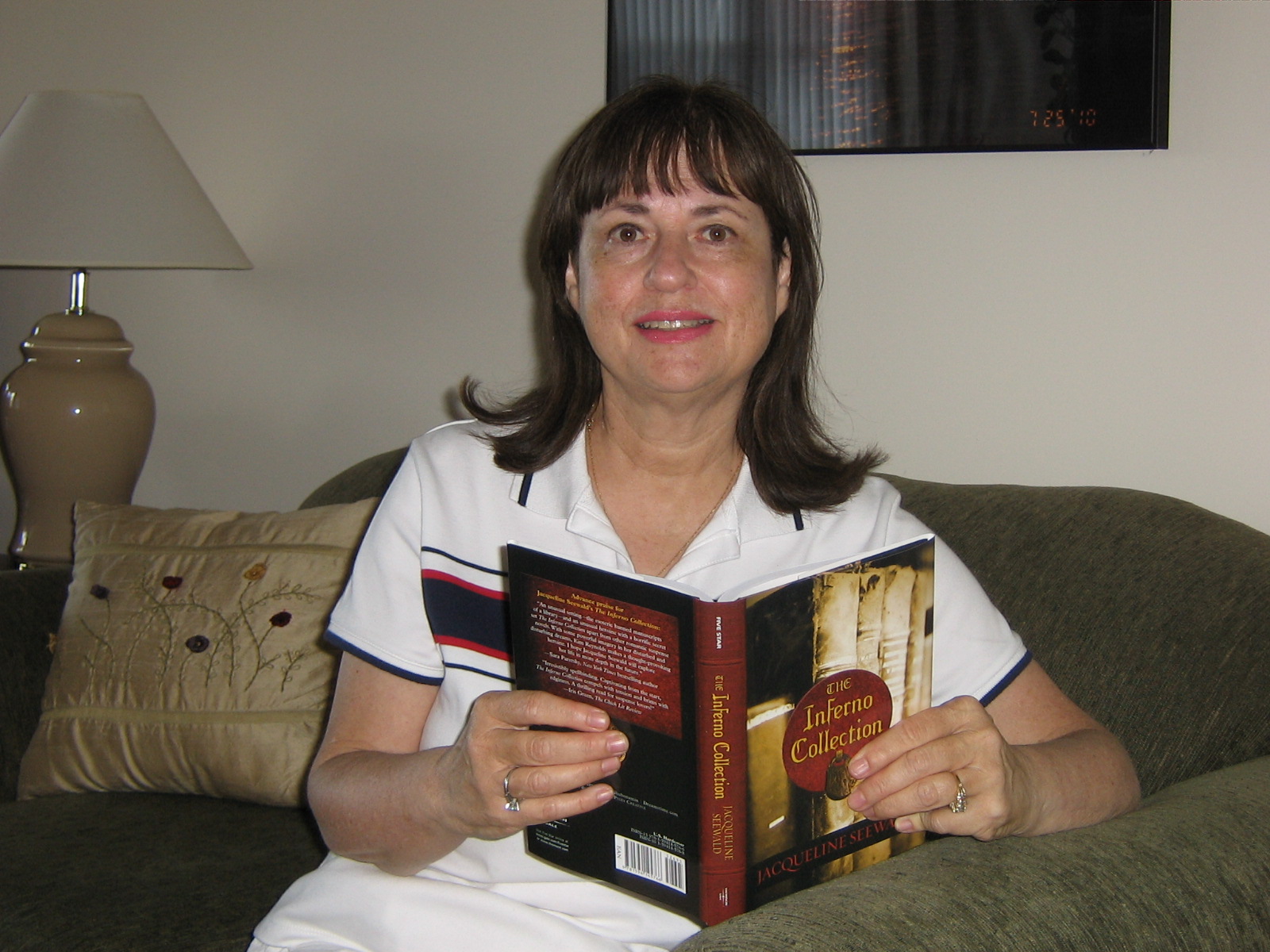
So what typically inspires a novel? What sparks a book series? With the Kim Reynolds librarian sleuth series (THE INFERNO COLLECTION, THE DROWNING POOL, THE TRUTH SLEUTH) the idea started with a lecture given at a symposium for grad students in the library science program at Rutgers University. A Princeton professor/librarian was lecturing on the subject of inferno collections. I was totally fascinated and decided to do some research on the subject on my own. I thought this would be an interesting frame for a mystery novel. THE INFERNO COLLECTION, initially published in hardcover and then large print, was the result. The novel is available in libraries all over the world, also available in all e-book formats: Kindle, Nook, Kobo, Overdrive, etc. http://www.lldreamspell.com/JacquelineSeewald.htm


When a reader/reviewer of my novel asked if inferno collections actually exist, I responded that not only did they exist in the past but still exist in more sophisticated and subtle forms today.
I am not saying that we should anticipate a burning of the vanities as with Savonarola's followers in the past, nor do I believe as in Ray Bradbury's Fahrenheit 451, that the firemen of the future will feel compelled to burn and destroy books.
It is a fact, however, that librarians have viewed themselves as gatekeepers. For example, libraries such as Boston Public at one time found it necessary to maintain separate inferno collections of banned books considered inappropriate for general public display and reading. Often these were books deemed salacious such as James Joyce’s Ulysses.
Did narrow attitudes end with the Victorian era’s sensibilities and prejudices? Apparently not. In the 1950’s, Senator Joseph McCarthy instigated one of the most notorious waves of censorship the nation has ever experienced. Because of McCarthy’s ‘Red Scare’, classics like Henry David Thoreau’s Civil Disobedience, which encouraged men to peacefully protest unjust laws, was pulled from the shelves of the State Department’s overseas libraries. It was one of more than 300 titles McCarthy had banned or burned.
J.D. Salinger's 1951 classic coming-of-age novel, The Catcher in the Rye, has been the object of challenges nationwide for decades because of its language, references to violence and sexual content. According to the American Library Association, the book was the 13th most frequently challenged book in the country's school systems from 1990 to 2000.
In 2005, the Metropolitan Library Commission of Oklahoma City overruled recommendations made by library staff and established a special collection of children’s books with gay themes. The collection would be accessible only to adults. The Oklahoma debate began when a state representative worried that children would have access to books about gay marriage and sponsored a resolution to segregate all library books with gay and/or adult themes.
The list of “condemned” banned or censored books boggles the mind. It is not only governments and libraries that have chosen to ban books found objectionable for various reasons. Materials are often deemed unacceptable for political or religious reasons or are considered profane, pornographic or sexually too explicit for youth. Publishers and booksellers make these decisions and determinations as well. The advent of e-book self-publishing has tipped the balance in that regard.
It is well to keep in mind that good books often stir controversy. They are designed to question and make people think. That is not something to fear or repress but rather to admire and respect. As Voltaire, author of the banned satire Candide, once stated: “I do not agree with what you have to say, but I'll defend to the death your right to say it.”
Today the internet is a largely unrestricted location to find information, including the subject of banned book collections. As to inferno collections, are they a thing of the past? Knowing human nature, it’s doubtful.
As a reader and/or writer, what trends do you find interesting in publishing? Do you see banned books as a thing of the past? What ideas or information inspire you to write?
What inspires you to write or want to write? What do you enjoy reading? Your thoughts and opinions valued here in this forum for open discussion!


Note: To celebrate the February 2012 large print edition of THE TRUTH SLEUTH from Kennebec, division of Thorndike Press, as well as the February 2012 paperback edition of THE DROWNING POOL from Harlequin Worldwide Mystery, I am offering a paperback copy of The Drowning Pool to a commenter. Leave an e-mail or web address if interested. Winner will be drawn at random and announced next week in Author Expressions.